Most Florida businesses are still chasing rankings on a Google that already changed without them.
In 2026, when a buyer asks ChatGPT for the best bilingual marketing agency in Tampa, or asks Perplexity which Florida PR firm specializes in Latina founders, or types a query into Google and reads the AI Overview at the top, the answer arrives before they ever scroll to the list of links. The buyer reads the AI's response, picks one of the cited sources, and clicks. The unlisted brands are invisible. The rankings the business spent two years chasing on page one never get seen.
This guide is the playbook for the new visibility. I have spent the last year applying AI search optimization to my own brand and to client work across beauty, hospitality, wellness, fintech, education, and tourism. What follows is what works, what does not, and a 30-day plan you can execute starting today.
What's inside
- Why AI search visibility matters for Florida in 2026
- The four AI search engines you need to know
- The mistake most Florida brands make
- The technical layer that gets you cited
- The content layer that gets you remembered
- The bilingual edge in AI search
- Florida-specific opportunities
- Case study: how this method got cited by Google AI in 5 days
- Your 30-day AI search visibility plan
- When to DIY versus bring in help
- FAQ: questions founders ask me every week
Why AI search visibility matters for Florida in 2026
The shift from traditional search to AI search is the largest change in buyer discovery behavior since Google indexed the early web. Industry reports from Gartner and BrightEdge estimate that AI search will absorb between 25% and 50% of traditional Google search volume by the end of 2026. ChatGPT crossed 600 million weekly users, Perplexity grew over 800% year over year in 2025, and Google AI Overviews now appear on over 47% of all search queries according to Semrush's June 2026 data.
For Florida specifically, the buyer behavior shift hits harder for three reasons. First, Florida's mixed urban and tourist economy means buyers research businesses across multiple search behaviors, including AI-driven recommendation queries like "best wedding photographer in Tampa for a bilingual ceremony." Second, the state's bilingual market amplifies the opportunity because Spanish AI search has far fewer authoritative sources to cite, leaving more room for boutique brands to be the cited source. Third, Florida's mature tourism and hospitality sectors are early adopters of AI search behavior, which means the visibility window opens earlier here than in many other US markets.
The brands that get found in 2026 are the brands that show up when AI answers. The brands that disappear are the ones that kept optimizing for Google as it was in 2022.
The five AI search engines you need to know
Five AI engines drive almost all AI search visibility opportunity for a Florida business in 2026. Optimizing for the structural patterns they reward covers more than 90% of the citations you can earn.
ChatGPT (with web search). ChatGPT's web search is powered by the Bing index, which means anything that ranks well in Bing and has clean structured data tends to get pulled by ChatGPT. The most reliable signals are: a verified Bing Places listing, FAQPage schema on key pages, citations and links from authoritative sources, and clear topic depth on a focused subject. ChatGPT cites between three and seven sources per answer typically.
Perplexity. Perplexity crawls the web independently and is the most generous AI search engine for citations, often listing eight to fifteen sources per answer. Perplexity rewards content that directly answers a question, with clean structured data, factual claims supported by sources, and conversational clarity. Reddit, LinkedIn, Substack, Wikipedia, and high-authority industry publications are weighted heavily in Perplexity's citation patterns.
Google AI Overviews. The AI summary that appears at the top of Google search results uses a different ranking system than the underlying organic results. AI Overviews favor pages with comprehensive depth on a focused topic, FAQPage and Article schema, conversational headers (questions phrased as headers tend to be pulled directly), and content with clear definitions, lists, and quoted statistics. AI Overviews now appear on roughly 47% of all Google queries.
Gemini and Microsoft Copilot. Google's standalone Gemini app and Microsoft's Copilot (formerly Bing AI Chat) both pull from their parent indexes (Google and Bing respectively) but apply additional structured-data preference. Listings in Google Business Profile and Bing Places are weighted strongly here. For local Florida businesses, these two engines are often the first place a buyer's AI tool will check.
Claude (Anthropic). Claude is the AI assistant favored by tech-forward founders, marketers, researchers, and B2B buyers. Claude's web search, powered by Brave Search as its underlying index, cites sources directly and tends to favor authoritative, well-sourced content over keyword-stuffed pages. Claude is increasingly used for research and decision-making in higher-ticket buyer journeys, which matters disproportionately for boutique service businesses and consultative offerings. Optimizing for Claude follows the same pattern as Perplexity: clear answers, real citations, conversational depth.
The mistake most Florida brands make
The mistake is optimizing for AI search the same way they optimized for Google in 2015. Keyword density, link-building campaigns, and ranking-focused content do almost nothing for AI search visibility. AI engines do not rank, they cite. The optimization is structural and semantic, not positional.
A Florida brand with great SEO might rank on page one for "bilingual PR agency Florida" but never get cited by ChatGPT for the same query, because the underlying content is shallow, lacks schema, has no direct Q&A formatting, and reads like marketing copy instead of an answer to a question. AI tools skip past it and cite the deeper, more structured source even if that source ranks lower in regular Google.
AI engines do not rank. They cite. Visibility now equals citation, not click-through.
The fix is to restructure how you build content. Each page should answer a specific question directly, with schema that confirms what the page is about, citations that confirm the facts, and depth that confirms expertise. Every page becomes a potential AI citation source, not just another link in a ranking list.
Curious if your site is AI-ready?
The Visibility Audit checks your AI search visibility across ChatGPT, Perplexity, Google AI Overviews, and Bing AI Chat, plus your local Florida listings, in 48 hours.
Get the Visibility Audit ● $800The technical layer that gets you cited
The technical layer is what tells AI engines exactly what your page is about. Without it, AI tools have to guess. With it, they have certainty. Certainty earns citations.
FAQPage schema. The single most important schema for AI search in 2026. FAQPage schema lets you publish a list of questions and answers in structured JSON-LD that AI tools can extract directly. Pages with FAQPage schema get cited 3 to 5 times more often than pages without it. Every cornerstone page on your site should have an FAQ section with FAQPage schema. Eight to thirteen questions per page is the sweet spot.
Article schema with author entity. Article schema confirms who wrote the content, when, and what it is about. The author field is increasingly important because AI engines use it to assess expertise. Link the author field to a real Person entity with a job title, organization, and links to verified social profiles (LinkedIn, Instagram) using the sameAs property.
Organization schema with sameAs links. Your home page should declare your business as an Organization entity, with sameAs links to your verified profiles on Google Business, Bing Places, LinkedIn, Instagram, Facebook, and other authoritative platforms. This is how AI engines build a unified picture of your brand across the web. Inconsistent or missing brand entity data confuses AI tools and reduces citation likelihood.
BreadcrumbList schema. Helps AI tools understand the hierarchy and topic categorization of your site. Small impact individually, large impact when combined with the others.
Hreflang for bilingual content. If you publish in two languages, hreflang tags tell AI engines which version targets which audience. Without hreflang, Spanish and English versions can confuse AI tools and reduce citation rates in both languages.
Clean meta titles and descriptions. AI Overviews and ChatGPT often pull the meta description verbatim. Treat each meta description as a chance to write the citation snippet yourself.

The content layer that gets you remembered
The content layer is where most brands fail because they keep writing marketing copy and expecting AI engines to cite it. AI engines do not cite marketing copy. They cite answers.
Write in answers, not pitches. Every section of every important page should answer a specific question a buyer would actually ask. Use the question as the header (H2 or H3). Answer it directly in the first sentence of the paragraph beneath it. Then expand with detail. AI tools extract the first sentence after a question header more often than any other content element.
Cite sources within the content. When you make a factual claim, cite where it comes from. "Industry reports from Gartner estimate that..." gives AI engines confidence in the data and increases the likelihood of citation. Vague claims like "studies show" or "experts agree" are skipped.
Use specific numbers and proper nouns. Generic statements get filtered. Specific data points and named entities (companies, people, places, products) get extracted. "Florida hosts more than 130 million annual visitors" is more citable than "Florida is a major tourism state."
Write in plain declarative prose. AI engines prefer clear, direct sentences over flowery brand language. Editorial elegance is fine, but it should be in the rhythm, not in obscure phrasing. "Bilingual marketing means designing strategy natively in two languages" gets cited. "We craft transcendent multilingual narratives that elevate brand essence" does not.
Depth beats breadth. One 3,000 word page that fully answers a focused topic outperforms ten 500 word pages that touch the same topic from different angles. Depth signals expertise. Expertise earns citations.
Update regularly. AI engines weight recently updated content more heavily, especially on fast-moving topics like AI search itself. Update key pages every quarter. Add new sections, refresh statistics, refine the FAQ. The dateModified field in your schema gets read directly.
The bilingual edge in AI search
Spanish AI search visibility in 2026 has dramatically less competition than English. AI engines have fewer authoritative Spanish sources to cite from in most niches, which means a Florida business publishing strong native Spanish content with proper hreflang can dominate Spanish AI citations in their topic within weeks.
This is one of the largest underutilized opportunities in AI search right now. Most American agencies write in English first and translate, producing low-quality Spanish that AI engines deprioritize. The brands publishing transcreated (natively written) Spanish content, with full bilingual schema and proper hreflang setup, capture the Spanish AI citation pool almost uncontested.
For Florida specifically, where bilingual buyer behavior is the norm rather than the exception, this means a bilingual brand can earn AI citations in both English and Spanish for related queries, effectively doubling visibility surface area for the same content investment.
Florida-specific opportunities
Five Florida industries have unusually strong AI search visibility opportunity because their buyer behavior shifted toward AI search faster than the average national category.
Hospitality and tourism. Travelers planning Florida trips increasingly use ChatGPT and Perplexity for itinerary research. Hotels, restaurants, tour operators, and event venues that publish AI-optimized content (FAQPage schema, bilingual, specific local context) capture booking-intent queries that traditional Google rankings miss.
Real estate. International buyers researching Florida property use AI search heavily. Real estate brands with structured content on Florida neighborhoods, bilingual buyer guides, and clear schema get cited in AI answers to "best neighborhoods in Tampa for families" or "what to know about buying a vacation home in Miami."
Healthcare and wellness. Health and medical queries are among the most AI-Overview-saturated query categories. Florida healthcare practices with proper Article schema, author credentials, and depth on conditions or treatments get cited in AI Overviews far more often than competitors.
Beauty and skincare. The Latina beauty consumer in Florida queries in both English and Spanish on AI tools heavily. Brands with bilingual product information, ingredient education, and ritual content earn AI citations across both audiences.
Boutique service businesses. Coaches, consultants, agencies, designers, photographers, planners. The smaller the niche, the higher the AI citation opportunity, because national competitors have not bothered to optimize for narrow Florida-specific queries.
Want help mapping your AI visibility strategy?
Two minutes to tell me what you're building. If we're a fit, we book a call. If not, I'll point you to the right next step.
Start a ConversationCase study: how this method got cited by Google AI in 5 days
On June 3, 2026, I published the companion guide to this playbook, "Bilingual Digital Marketing in Florida: The 2026 Founder's Playbook." Five days later, the post had earned visibility across three different Google ranking systems at the same time. The timeline below is documented in real time and verified in incognito browsing to remove personalization bias.
Day 1 ● Published. The blog post went live with FAQPage schema, Article schema, BreadcrumbList schema, hreflang tags for EN and ES, and native bilingual content. Submitted to Google Search Console for indexing within the hour.
Day 2 ● Indexed. Google crawled and indexed the URL. First impressions started appearing in Search Console performance reports.
Day 3 ● Top 3 in Google Maps. For the query "Bilingual PR Agency Tampa," the Lu PR business listing reached the top 3 organic positions in Google Maps for Florida-based searches.
Day 4 ● Cited by Google AI Overview. The blog post URL appeared as a cited source inside Google's AI Overview answer for "Bilingual marketing and PR in Florida." Verified in incognito on multiple devices.
Day 5 ● Page 1 organic. The blog post ranked on page 1 of Google organic search for multiple bilingual marketing queries, including "Bilingual marketing and PR in Florida," "Bilingual PR agency Tampa," "Bilingual marketing agency Tampa," and "Latina-owned PR agency Florida."
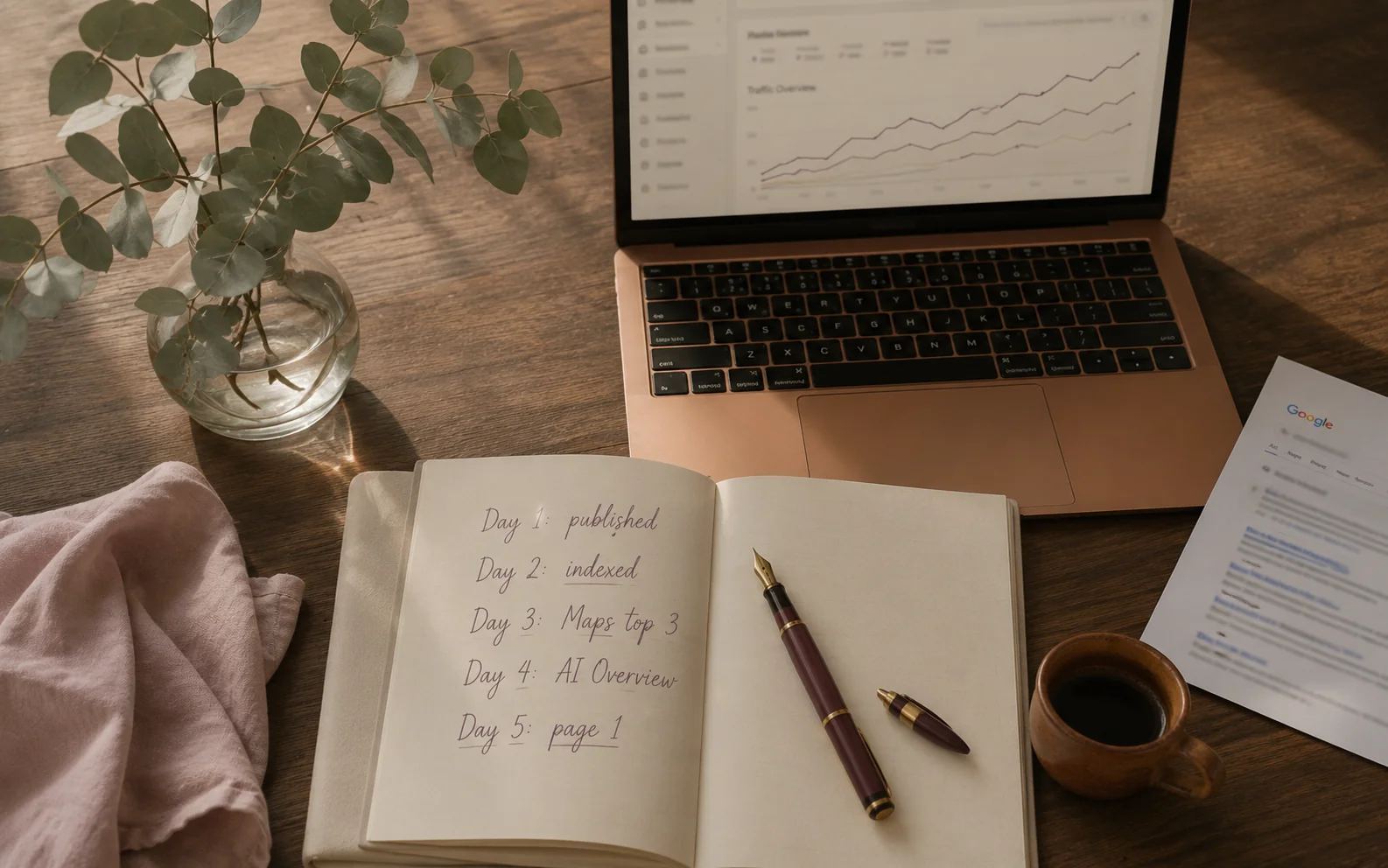
Three different Google ranking systems. Five days. No paid ads. No backlink campaigns. No tricks. Just the method documented earlier in this playbook, applied to a single piece of content with the structural discipline AI engines reward.
This is what optimizing for citation looks like in 2026. Not gaming algorithms. Building structured, authoritative, native content that AI engines actually want to quote, and then showing up consistently across the directories and platforms they cross-reference.
Five days is fast. The method is not. The discipline is what made it possible.
Your 30-day AI search visibility plan
You do not need to rebuild your site to start. You need to compound six specific moves over thirty days.
Days 1 to 5. Audit your current AI search visibility. Search your brand and three key topics in ChatGPT, Perplexity, and Google (with AI Overviews enabled). Note whether you appear, whether you are cited, and what gets cited in your place. Document the baseline.
Days 6 to 10. Add FAQPage schema to your three highest-priority pages (home, primary service page, cornerstone content). Eight to thirteen questions per page, written as direct answers a buyer would ask. Validate the schema with Google Rich Results Test.
Days 11 to 17. Optimize your business listings for AI search. Claim or update your Bing Places listing (Bing powers ChatGPT). Update your Google Business Profile with bilingual description, attributes, and weekly Posts. Add sameAs links across both to connect your brand entity.
Days 18 to 24. Write or rewrite one cornerstone blog post in your top topic. Use the question-as-header pattern. Cite three to five authoritative sources within the content. Add FAQPage schema, Article schema, and BreadcrumbList. Publish in both languages with hreflang if you operate bilingual.
Days 25 to 28. Outreach for citation surface. Get listed in three to five additional directories or industry publications that AI engines crawl heavily (Clutch, DesignRush, Hispanic Marketing Council, local Tampa or Miami business directories). Each listing is a citation source that AI engines pull from.
Days 29 to 30. Re-audit. Search the same three topics in ChatGPT, Perplexity, and Google with AI Overviews. Compare to your day-one baseline. The earliest citations should start appearing within this window for at least one query.
When to DIY versus when to bring in help
AI search visibility is one of the disciplines where the gap between knowing the tactics and executing them well is wide. Some founders close that gap on their own. Others compound faster by working with someone who lives in this every day.
DIY makes sense when you are comfortable with technical SEO, you have at least four hours a week to invest, and your business does not have urgent visibility needs in the next 60 days.
Bringing in help makes sense when you have a launch coming up, when your industry has technical complexity that requires nuanced AI optimization, when you are not bilingual but want to capture the Spanish AI citation opportunity, or when DIY has not produced measurable citation improvement in 60 to 90 days.
If you want a self-paced starting point, The Quiet Launch trilogy at $47 covers the AI search visibility fundamentals as part of the bilingual launch framework. If you want a hands-on diagnostic, the Visibility Audit at $800 covers your AI visibility specifically in 48 hours. If you want a strategist embedded in your visibility work, the monthly retainer starts at $3,000.

Sources and references
- Google Search Central, AI features and your website (AI Overviews documentation)
- Google Search Central, FAQPage structured data documentation
- Schema.org, Article schema specification and FAQPage schema specification
- OpenAI Help Center, ChatGPT Search overview
- Anthropic, Claude product page and citation behavior
- Microsoft Bing Webmaster Tools, Bing Webmaster Guidelines
- US Census Bureau, Florida QuickFacts (demographic data)
- Pew Research Center, Facts on Hispanic and Latino Americans