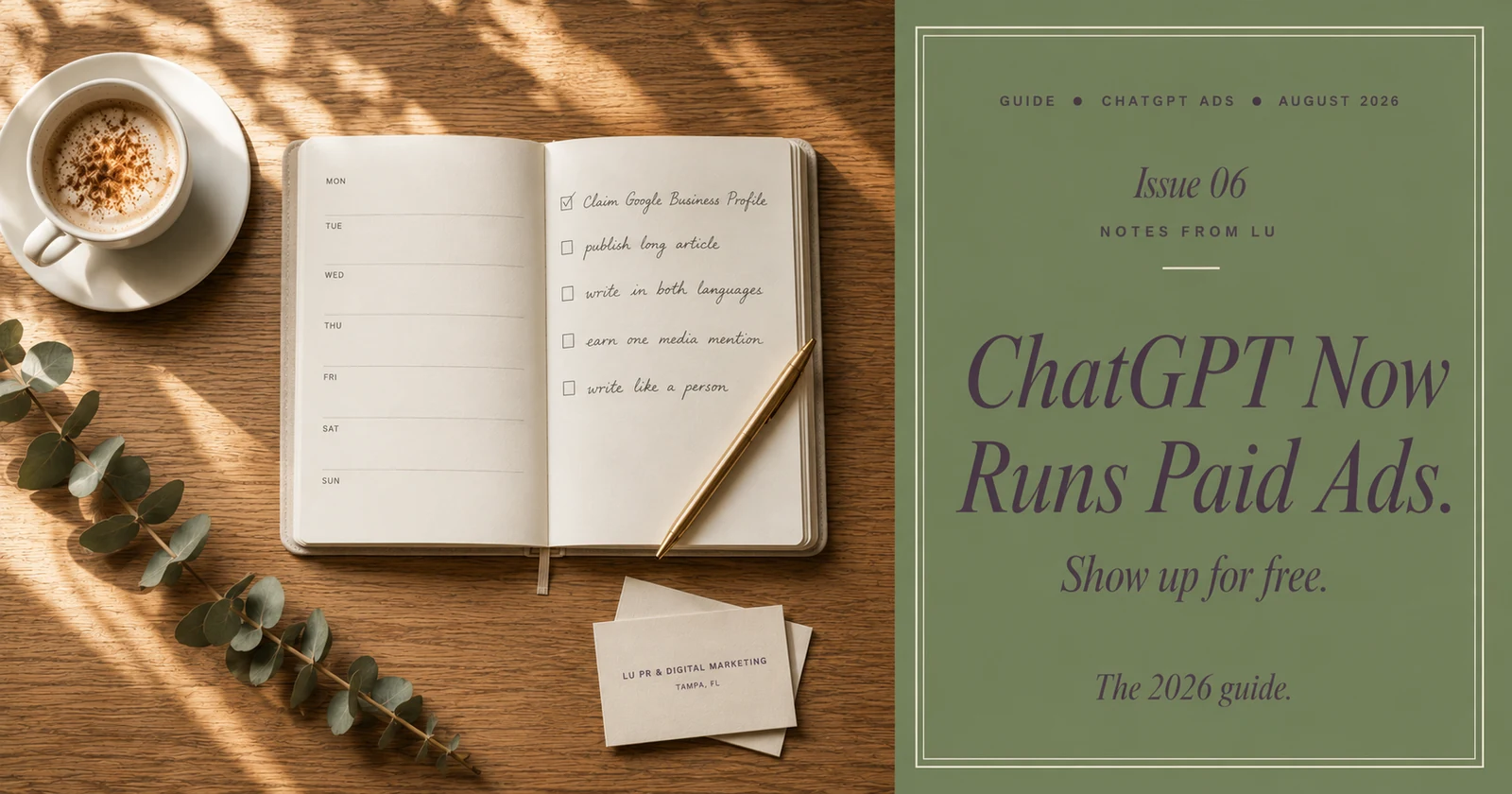
In July 2026, OpenAI fully launched paid advertising inside ChatGPT. The self-serve Ads Manager had opened to US businesses in May, and by August the platform expanded to thirty-one European countries.
For the first time in ChatGPT's history, brands can now pay to appear alongside the conversations millions of people have with it every day. Advertisers can bid, target, and measure inside the same interface they already know from Google and Meta.
Which raises the question every small business owner should be asking right now: what does this mean for the businesses that cannot afford to buy ads inside ChatGPT? The ones without a $10,000 monthly budget, without a media agency, without a paid-media specialist on staff. The 93% of Latina-owned businesses that operate without employees. The founders building bilingual brands from Tampa, Miami, or Orlando trying to be found by a client who is asking ChatGPT for a recommendation.
Here is the honest answer, and it is better news than the headlines suggest.
ChatGPT ads and ChatGPT's organic answers are separate systems. OpenAI has stated this publicly, in their own Help Center documentation. Advertisers cannot pay to influence, rank, or alter the response text ChatGPT generates when someone asks it a question. Paid placements appear alongside conversations. The organic answer, and the sources ChatGPT chooses to cite, remain independent.
You can buy an ad placement. You cannot buy your way into ChatGPT's organic answer.
Which means the small businesses that build defensible organic AI visibility right now, quietly, before attention shifts entirely to paid, are the ones AI will keep citing as more competitors flood the same category.
This guide is the exact playbook I use with every founder inside my Small Business Starter Setup. Five things you can do this week. A 30-day plan. The bilingual advantage most agencies are ignoring. And a free printable checklist you can download and put on your desk.
What's inside
- What actually changed with ChatGPT ads in 2026
- Why organic AI visibility matters more, not less
- The 5-step foundation to be found by ChatGPT this week
- Download the free printable checklist
- Advanced signals that separate cited sources from ignored ones
- The bilingual advantage most agencies are ignoring
- Common mistakes small businesses are making right now
- How to measure whether ChatGPT is finding you
- Your 30-day action plan
- When to DIY versus bring in help
- FAQ: what founders keep asking me about ChatGPT visibility
What actually changed with ChatGPT ads in 2026
The rollout of paid advertising inside ChatGPT is not a single event. It is a phased launch that has been playing out through the entire year. Understanding the timeline matters because a lot of internet advice was written before the full picture was clear.
February 9, 2026 ● Pilot launch. OpenAI began testing ads inside ChatGPT with logged-in adult users on the Free and ChatGPT Go tiers, initially in the United States. Access was invite-only for advertisers, with a reported minimum spend requirement in the six figures. This was a closed test with a small number of brands.
May 5, 2026 ● Self-serve Ads Manager. OpenAI opened a self-serve ChatGPT Ads Manager to US businesses, removing the pilot's minimum spend and introducing CPC (cost-per-click) bidding alongside CPM. For the first time, small and mid-sized businesses could theoretically buy ads inside ChatGPT directly, without an agency or managed-service relationship with OpenAI.
July 22, 2026 ● Full launch. OpenAI fully launched the "Advertise in ChatGPT" platform, with expanded targeting, campaign objectives, and creative formats. This is the version most businesses will interact with going forward, at ads.openai.com.
August 18, 2026 ● International expansion. The platform expanded to thirty-one European countries. Additional international rollout is expected through the rest of the year.
Throughout all of this, one fact remained consistent, and it is the one that matters most for small businesses. According to OpenAI's own published Help Center documentation, ads inside ChatGPT are shown alongside conversations, not inside the organic answer. Advertisers cannot pay to be recommended, cited, or ranked higher in the response text. The two systems are separate.
Why organic AI visibility matters more, not less
When any category shifts to paid, attention floods in. Big brands bid. Small brands assume they have been priced out. The playing field appears to close.
Except in AI search, the playing field for organic citations is a different playing field entirely. It runs on its own logic, its own signals, and its own competitive dynamics. And it rewards a set of behaviors that small businesses can execute better than large ones.
Large brands are optimized for scale. They publish templated content, they optimize for keyword volume, and they let paid media do the heavy lifting of visibility. That approach worked in the Google era. It underperforms in the AI search era, because AI engines prefer specific, sourced, structured, focused content over shallow templates.
Small businesses, when they show up honestly, tend to publish depth over breadth. They speak in a specific voice. They know their niche cold. They have real client stories, real regional context, real bilingual reach that a national agency will never invest in. Those are the exact signals AI engines look for when deciding what to cite.
The founders who become established as trusted sources for their category right now, before their competitors catch up, tend to keep being cited as the category matures. Early-mover advantage in organic AI citations is a compounding asset. Established sources are usually cited before newer, less-established ones. This is one of the most consequential dynamics in AI search visibility in 2026, and almost no one is talking about it.

The 5-step foundation to be found by ChatGPT this week
Everything below is what I do with every founder inside my Small Business Starter Setup. These are the five moves that build the structural signals AI search engines can find and trust. You can do them this week. In order.
One. Complete your Google Business Profile. Every field. Every photo. Every category. Every service. Business hours accurate down to holiday exceptions. A complete Google Business Profile strengthens the structured local signals AI search can encounter across the web. It is the single fastest move a small local business can make to become discoverable across Google, Google AI Overviews, and AI engines that pull from Google's local data.
Two. Publish one in-depth article on your own website. Not a caption. Not a Canva graphic. Not a repurposed Instagram carousel. A real 1,500 to 2,500 word article on your own domain that answers a specific question your ideal client actually asks. Your own domain is one of the only surfaces AI can discover, understand, and potentially cite. Social platforms are difficult for AI engines to attribute to a specific business entity. Your own domain is not.
Three. Publish in both languages if you are bilingual. Native voice in each language, not translated word for word. Bilingual brands give AI more opportunities to be discovered across English and Spanish queries. AI engines have fewer authoritative Spanish sources to draw from in most niches. Bilingual brands with proper hreflang setup and native content build citations across both languages faster than English-only competitors.
Four. Get named in one credible outside source. A guest post on a peer's blog. A podcast feature. A local news mention. A verified industry directory listing. For AI visibility, one credible third-party mention can be more valuable than another twenty social posts. Third-party references help AI engines understand who your business is and what it does, from a source that is not you.
Five. Write for the person asking the question. Be specific. Be useful. Be unmistakably yours. Skip keyword stuffing. AI engines are increasingly trained to filter out generic marketing prose in favor of writing that clearly addresses a real question with real detail. Sound like the way your best client would ask the question, then answer it the way you actually would in a Zoom call.
Free ● Printable ● No email required
Download the one-page checklist.
Print it. Put it on your desk. Check off one thing this week. The five moves above, distilled into a single editorial page you can act on.
Download the checklistPDF ● Letter size ● Print ready ● 56 KB
Advanced signals that separate cited sources from ignored ones
The five moves above are the foundation. The signals below are what separate the businesses AI cites regularly from the ones AI mentions once and forgets.
Schema markup on every important page. FAQPage schema is the single most powerful piece of structured data for AI search. Pages with clean FAQPage schema get pulled into AI answers noticeably more often than pages without. Article schema, Organization schema, and BreadcrumbList schema add up in aggregate. If your site has zero structured data, that is the first place I would invest a few hours this month.
Author entity clarity. AI engines are learning to weigh who wrote a piece of content, not just what it says. Link your Article schema author field to a real Person entity, with a job title, an organization, and sameAs links to your verified LinkedIn and Instagram. If your content reads like it came from an anonymous marketing team, AI has less confidence in citing it.
Consistent brand entity across the web. Your business name, address, and description should match everywhere. Google Business Profile, Bing Places, LinkedIn company page, Instagram bio, Facebook page, industry directories. Inconsistencies confuse AI's ability to unify your brand into a single trusted entity. Consistency is quiet, cumulative, and highly underrated.
Cite sources inside your own content. When you make a factual claim, link to where the data comes from. AI engines have more confidence citing content that itself cites credible sources. It also signals to the reader that you are trustworthy, which improves engagement metrics AI engines can indirectly detect.
Update your important pages every quarter. The dateModified field in your Article schema is read directly by AI engines. Fresh content on a moving topic (AI search itself moves quickly) gets weighed more heavily. Refresh statistics, add new FAQs, update your timeline. Small changes signal a living page, not a static one.
Want me to build this foundation for you?
The Small Business Starter Setup builds everything above in English and Spanish. Google Business Profile, editorial content on your domain, schema markup, and the exact AI search visibility signals I cover in this article. Setup done in weeks, not months.
Get the Starter Setup ● $497 launchThe bilingual advantage most agencies are ignoring
Almost every conversation about AI search visibility is happening in English. Almost every playbook is written for English-first businesses. And almost every large agency treats Spanish content as an afterthought, translated cheaply from English at the end of the process.
This is one of the biggest advantages a bilingual small business has in AI search in 2026.
AI search engines have significantly fewer authoritative Spanish sources to draw from in most niches. When someone asks ChatGPT for a bilingual PR agency in Tampa, or a Latina-owned marketing consultant in Miami, or how to market a small business en español, the pool of businesses AI can even consider citing is shallower than the English equivalent.
Small bilingual businesses that publish native (not translated) content in both languages, with proper hreflang setup, effectively play in two separate citation pools with less competition in one of them. The same investment in one blog post, translated properly into a second native version, doubles the potential visibility surface.
For Florida specifically, where bilingual buyer behavior is the norm rather than the exception, this advantage compounds. A Latina founder in Tampa or a bilingual consultant in Orlando can build organic AI visibility faster than a national English-only competitor, in half the time, with half the content investment.
This is why every service Lu PR offers, from the Small Business Starter Setup to the Visibility Audit, is built bilingually from day one. Not because it is trendy. Because it is the largest structural advantage available to founders like the ones I serve.

Common mistakes small businesses are making right now
Every week I audit sites for founders asking why they are not showing up in ChatGPT. The same handful of mistakes come up in almost every one.
Publishing only on social media. If your entire content presence is inside Instagram, LinkedIn, and TikTok, AI engines have very little to cite. Social content is difficult for AI to attribute to a specific business entity and rarely gets pulled into organic answers. Your own domain is the only surface AI can reliably discover and cite.
Thin, keyword-stuffed pages. Copy that reads like it was written for the algorithm of 2015 gets skipped by AI engines that were trained to filter out that exact pattern. Write in real, human, specific prose. If you would not read it out loud in a client meeting, do not publish it.
Zero schema markup. AI engines love certainty. Schema markup gives them certainty. Sites with no structured data at all leave AI to guess, and AI would rather cite a source that gave it confirmed data than one that made it guess. FAQPage, Article, and Organization schema are the minimum.
Ignoring Google Business Profile. Half-completed profiles are extremely common and are one of the fastest fixes a small local business can make. A complete profile is a strong local signal that flows into AI answers about local services.
Publishing in only one language when you speak two. If you are bilingual and publishing in only English, you are leaving the biggest structural advantage available to you unclaimed. Translate. Or hire someone who can transcreate. Or publish natively in both from the start.
How to measure whether ChatGPT is finding you
Direct citation analytics from AI engines do not yet exist. ChatGPT does not tell you when it cited you the way Google Search Console tells you when you got clicks. Measurement in 2026 is proxy-based, and it is still worth doing.
Manual citation audits. Once a month, search your brand name and your three most important topics inside ChatGPT, Perplexity, and Google with AI Overviews enabled. Do it in incognito mode to remove personalization bias. Note whether you appear, whether you are cited, and what gets cited in your place if you do not.
Referral traffic in Google Analytics. Filter your acquisition report for referrals from chat.openai.com, perplexity.ai, gemini.google.com, and copilot.microsoft.com. Traffic from these sources means your content is being read after appearing in an AI answer somewhere.
Google Search Console AI Overview impressions. Search Console now shows impressions from AI Overview appearances. Filter your Performance report for queries where AI Overview shows up and track your impressions over time.
Ask new clients how they found you. The most reliable signal for boutique service businesses. Add one field to your intake form. Track the answers. When a client says "I asked ChatGPT for a bilingual marketing agency in Tampa and you came up," you have a real signal that no analytics dashboard will give you.
Your 30-day action plan
You do not need to rebuild your site to start. You need to compound six specific moves over thirty days.
Days 1 to 3. Baseline your current visibility. Search your brand and three key topics in ChatGPT, Perplexity, and Google with AI Overviews. Record where you appear, who gets cited in your place, and what those cited sources have in common (schema, depth, domain type, sources).
Days 4 to 8. Complete your Google Business Profile. Every field. Add or update ten to fifteen photos. Write a fresh 750-character description that includes your bilingual angle, your primary service, and your city. Add at least one weekly Post going forward.
Days 9 to 16. Publish one substantive article on your own domain. 1,500 to 2,500 words. Question-as-header format. Cite three to five real sources within the content. Add FAQPage schema and Article schema. If bilingual, publish the native Spanish version with hreflang the same week.
Days 17 to 22. Earn one credible third-party mention. Pitch a guest post to a peer's blog. Get on one podcast. Get listed in one industry directory. Ask a satisfied client for a Google review that mentions your specific service by name.
Days 23 to 28. Add schema to two existing high-priority pages if you have not already. Home page and primary service page. FAQPage, Article, Organization, BreadcrumbList. Validate with Google's Rich Results Test.
Days 29 to 30. Re-audit. Search the same three topics in ChatGPT, Perplexity, and Google. Compare to your baseline. Initial improvements often appear within this window for at least one query.
When to DIY versus when to bring in help
The fundamentals of organic AI visibility can be self-implemented by any small business owner with a few hours a week and technical patience.
DIY makes sense when you are comfortable in your website's back end, you can dedicate three to four hours per week to this work, and your business does not have urgent visibility needs in the next 60 days.
Bringing in help makes sense when you want to skip the six-month learning curve, when you are bilingual and want the Spanish AI visibility built natively from day one, when you have a launch or product coming up that needs to be findable before it happens, or when you have tried the fundamentals for 60 to 90 days without measurable citation improvement.
If you want a self-paced starting point that covers the visibility fundamentals, The Quiet Launch trilogy at $47 is where I would begin.
If you want the full bilingual AI search foundation built for you in weeks, the Small Business Starter Setup at $497 launch price (through August 31, 2026) is the fastest way to go from invisible to findable.
If you want an ongoing bilingual visibility strategist embedded in your marketing, the monthly retainer starts at $3,000.
Not sure which path is right for you?
Two minutes to tell me what you're building. If we're a fit, we book a call. If not, I'll point you to the right next step, free.
Start a conversation
Sources and references
- OpenAI, New ways to buy ChatGPT ads (official announcement of the ChatGPT Ads program)
- OpenAI Help Center, Ads in ChatGPT (documentation that ads are separate from organic answers)
- Google Business Profile Help, How to complete your Google Business Profile
- Google Search Central, FAQPage structured data documentation
- Schema.org, Article schema specification
- US Bank & National Women's Business Council, 2026 data on Latina-owned businesses without employees