When a buyer types a question in Spanish into ChatGPT, Perplexity, Gemini, or Google AI Overview, the answer usually arrives without citing a single Spanish source.
This is not because Spanish content does not exist on the web. It exists, in massive quantities. It is because most of that content is invisible to AI engines for technical and linguistic reasons that almost no brand has fixed yet. The result is an enormous citation vacuum in Spanish AI search, and the few brands that fix the invisibility problem are capturing the cited spot in their niche almost uncontested.
This is the playbook for becoming one of those brands. Written from inside the work, applied to my own bilingual agency, verified in the wild.
I discovered it inside my own agency. I write natively in two languages. Even so, my Spanish content took longer to surface in AI engines than my English content. The reason was not how I was writing. It was 5 technical elements AI uses to verify language. And almost no one has them right.
What's inside
- The hidden problem with Spanish content in AI search
- The 5 fixes that make Spanish content citable
- Why this is the biggest underused opportunity in 2026
- How to audit your Spanish AI visibility in 10 minutes
- Your 30-day plan to fix it
- When to DIY versus when to bring in help
- FAQ: questions founders ask me every week
The hidden problem with Spanish content in AI search
AI search engines do not read content the way humans do. They scan structural signals (schema markup, language tags, citation patterns) and statistical signals (sentence rhythm, vocabulary frequency, idiomatic usage) to decide what is authoritative in a given language. When those signals are missing or contradictory, the AI engine defaults to whichever language has the strongest signal for that topic. For most topics in 2026, that is English.
So when a Spanish-speaking buyer asks ChatGPT about, for example, marketing strategy for small businesses, ChatGPT pulls from English-language sources and translates the answer on the fly, even when better Spanish sources exist somewhere on the web. The Spanish sources do not get cited. The English sources do.
This happens for five specific reasons, and each of them has a specific fix.
The 5 fixes that make Spanish content citable
Fix 1 ● Native writing, not translation. AI engines can detect translated content through statistical patterns. Translated text has a different rhythm than native text. Sentence structures inherited from the source language stand out. Idioms get mangled. AI engines treat this as low-quality and deprioritize it. The fix is transcreation, not translation. Write in Spanish natively from day one with the same strategic intent as your English content but the cultural specificity and search intent native to Spanish.
Fix 2 ● Hreflang tags configured correctly. The hreflang attribute is what tells AI engines that your Spanish page is a distinct version targeting Spanish speakers, not a duplicate of your English content. Every Spanish page should have hreflang tags in its head pointing to itself with the correct language code (hreflang="es" for generic Spanish or hreflang="es-US" for US Spanish speakers) and to its English counterpart. Most bilingual sites miss this and get treated as duplicate content by AI crawlers.
Fix 3 ● Spanish-specific schema with the inLanguage property. Schema markup (the invisible structured data that tells AI tools what your page is about) must include an explicit inLanguage field set to your Spanish variant. For US Spanish speakers, that is "es-US." For Mexican Spanish, "es-MX." For Spain, "es-ES." This field appears on Article schema, FAQPage schema, BreadcrumbList, and Organization schema. Without it, AI engines may treat your Spanish content as English with foreign words and skip it for Spanish queries entirely.
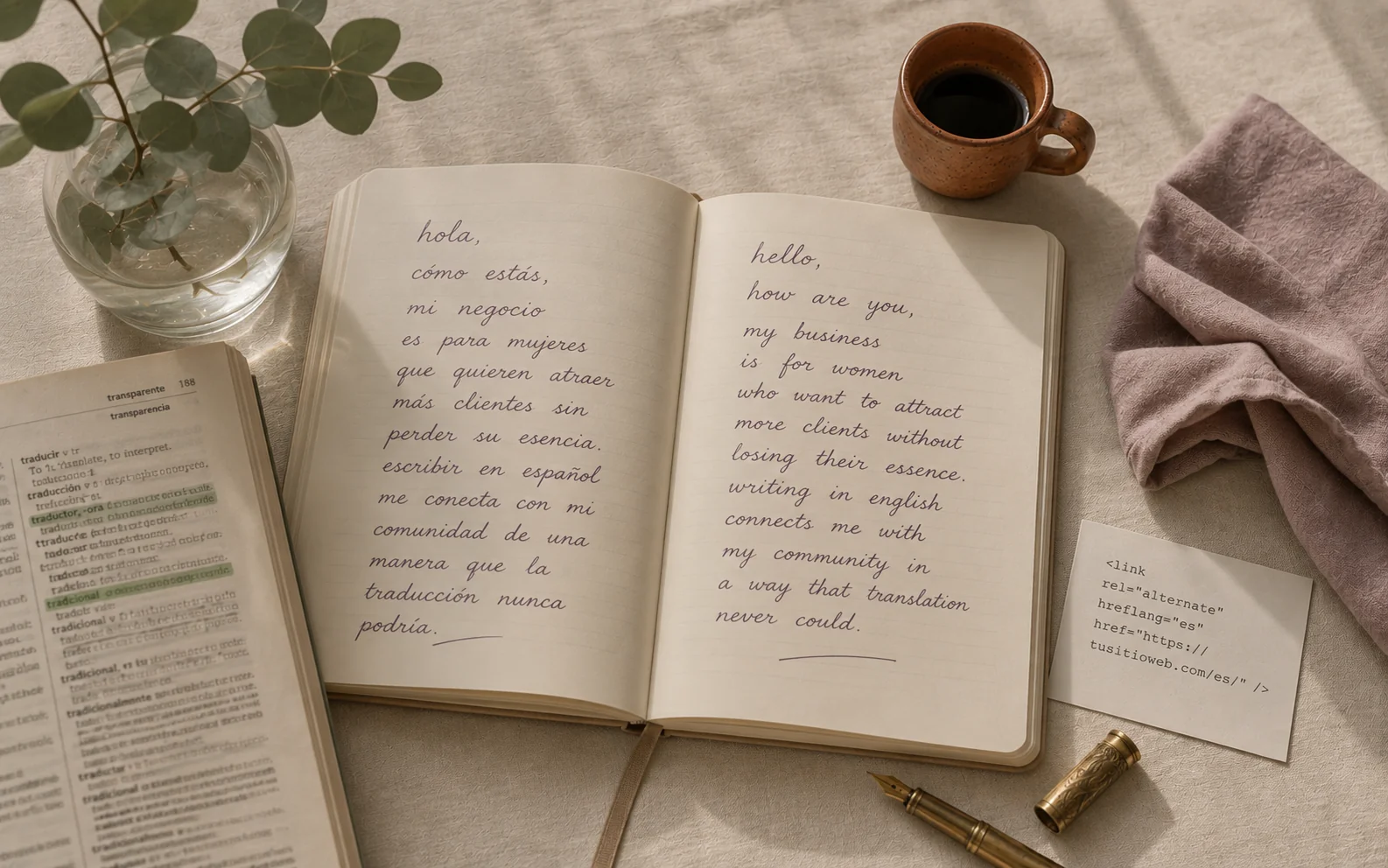
Fix 4 ● Dialectal regionalization. Spanish is not monolithic. Mexican Spanish, Cuban Spanish, Puerto Rican Spanish, Colombian Spanish, Argentine Spanish, and Castilian Spanish use different vocabulary, idioms, and rhythms. AI engines can detect dialectal patterns and match them to regional user queries. A page written in Mexican Spanish ranks better for Mexican search queries than a generic "neutral Spanish" page. For Florida specifically, where Cuban and Puerto Rican Spanish dominate, regionalizing your Spanish for the local dialect is a major competitive advantage that almost no brand is doing yet.
Fix 5 ● Spanish authority signals across the web. AI engines do not assess content in isolation. They assess your brand entity across the web. If your Spanish content lives on a single page on your site but your business is invisible in Spanish on Google Business Profile, Bing Places, Wikipedia, LinkedIn, and other authoritative platforms, AI engines will not see you as a Spanish-language authority. The fix is to publish bilingual presence everywhere your brand entity lives, with consistent Spanish content, descriptions, and metadata.
AI engines do not skip Spanish content because Spanish is harder to read. They skip it because it is harder to verify. The fixes are structural.
Want me to audit your Spanish AI visibility?
The Visibility Audit reviews your Spanish-language presence across AI search engines, hreflang configuration, schema language tags, and authority signals, with a prioritized fix list, in 48 hours.
Get the Visibility Audit ● $800Why this is the biggest underused opportunity in 2026
Spanish AI search has dramatically less competition than English AI search in almost every niche. Estimates from industry analysis suggest the volume of Spanish-language content optimized for AI citation is less than ten percent of English-language equivalent. That means the cited spot in your niche is functionally open in Spanish, even when it is fiercely contested in English.
For bilingual brands, this is the single largest underused growth opportunity in AI search in 2026. Publishing high-quality native Spanish content with proper hreflang and schema can capture Spanish AI citations in your topic within two to four weeks, often faster than equivalent English content takes to rank. The window will not last forever. As more brands wake up to this opportunity over the next twelve to twenty-four months, the citation vacuum will start to fill.
The brands that move now are positioning themselves to be the cited Spanish-language authority in their niche for the rest of the decade.
How to audit your Spanish AI visibility in 10 minutes
You can verify whether your Spanish content is invisible to AI search engines in three quick tests.
Test 1 ● The AI engine search. Open ChatGPT, Perplexity, or Google AI Overview. Search your topic in Spanish (for example, "mejor agencia de marketing bilingüe en Florida"). If your site does not appear in the cited sources, you are invisible. Try three to five different Spanish-language queries in your niche to confirm.
Test 2 ● The Google Search Console check. In Google Search Console, filter your Performance report by query type and look for Spanish-language queries. If your impressions for Spanish queries are at or near zero, even though you have published Spanish content, your Spanish pages are not being matched to Spanish searches. This usually indicates missing hreflang or schema.
Test 3 ● The HTML source check. Open your Spanish page in a browser, right-click, and select View Page Source. Use Cmd+F or Ctrl+F to search for "hreflang" and "inLanguage." If neither appears, you are missing the two most important Spanish AI signals. If they appear but use the wrong values (for example, "en" on a Spanish page), you have a configuration error.
If any of these tests fails, your Spanish content is invisible to AI search engines and you have a clear list of fixes to prioritize.
Building bilingual? Tell me what you're working on.
Two minutes to fill out the form. I read every one personally. If we are a fit, we book a call. If we are not, I will point you to the right next step anyway.
Start a ConversationYour 30-day plan to fix it
You do not need to rebuild your bilingual site from scratch. You need to compound five specific moves over thirty days.
Days 1 to 5. Run the three-test audit above. Document the baseline. Identify which pages on your site have Spanish content and which are missing hreflang, schema, or both. Make a list of the highest-priority pages (your homepage, your top-converting service pages, your cornerstone content).
Days 6 to 12. Add hreflang tags to your three highest-priority pages. Every page needs a self-referencing hreflang plus a hreflang pointing to its alternate-language version. Validate the configuration with Google Search Console's URL Inspection tool.
Days 13 to 18. Add or correct the inLanguage field in your schema markup for the same three pages. Set it to "es-US" if your audience is US-based Spanish speakers, or to the regional code that matches your audience. Validate with Google's Rich Results Test.
Days 19 to 24. Audit your existing Spanish copy on those three pages. Identify sentences that read as translated rather than native. Rewrite them in native Spanish with cultural specificity, regional dialect (if applicable), and search intent that matches how real Spanish speakers actually query your topic.
Days 25 to 30. Optimize your authority signals. Update your Google Business Profile description to include native Spanish. Add Spanish posts. Update your Bing Places listing with bilingual content. List your business in two to three Spanish-language directories relevant to your industry. Re-run the three-test audit and compare to your baseline. The first citations should start appearing within this window.
When to DIY versus when to bring in help
Spanish AI search visibility is one of the easier disciplines to DIY if you are bilingual yourself. The technical fixes are straightforward once you understand them, and the content rewrites are achievable with focused effort.
DIY makes sense when you are bilingual, comfortable with HTML and schema, and have at least three hours a week for the next month.
Bringing in help makes sense when you are not bilingual but want to capture the Spanish AI opportunity, when your industry has technical or regulatory complexity that requires careful Spanish translation, or when DIY has not produced citation improvement in sixty to ninety days.
If you want a self-paced starting point, The Quiet Launch trilogy at $47 covers the bilingual content framework. If you want a hands-on diagnostic, the Visibility Audit at $800 includes a full Spanish AI visibility review in 48 hours. If you want a strategist embedded in your bilingual visibility work, the monthly retainer starts at $3,000.

Sources and references
- Google Search Central, Tell Google about localized versions of your page (hreflang)
- Schema.org, inLanguage property specification
- Google Search Central, AI features and your website (Google AI Overviews)
- OpenAI Help Center, ChatGPT Search overview
- Anthropic, Claude product page and citation behavior
- US Census Bureau, American Community Survey, Language Spoken at Home
- Pew Research Center, Facts on Hispanic and Latino Americans
- Instituto Cervantes, El español: una lengua viva (annual report)