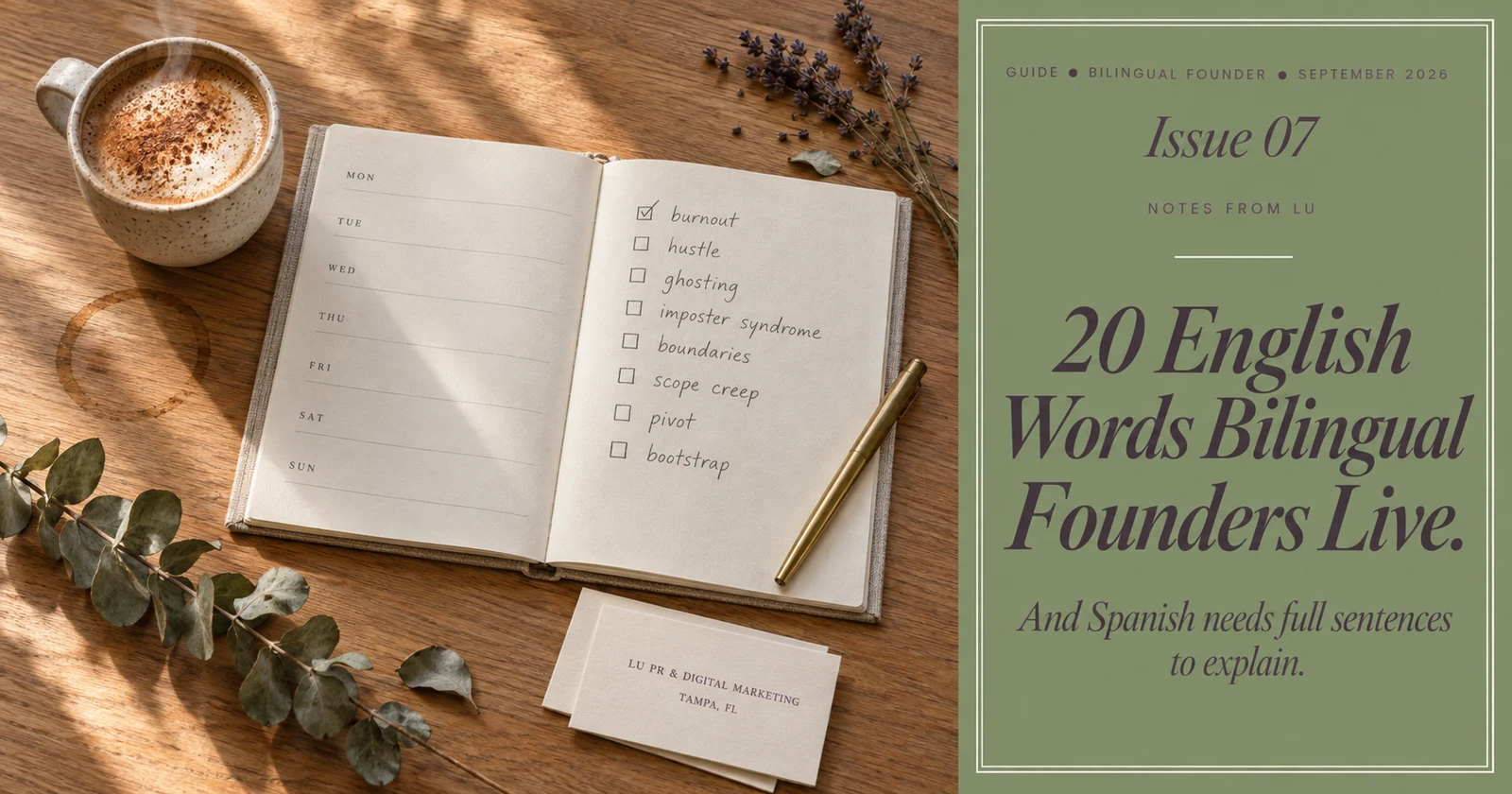
There are English words that bilingual Latina founders live so specifically, so viscerally, that Spanish needs an entire sentence to explain what happened.
Not because Spanish is less expressive. Spanish is a language of relational depth, emotional layering, and cultural nuance that English struggles to match. But English tends to compress complex business and psychological experiences into single words. Burnout. Hustle. Ghosting. Pivot. Boundaries. Each one carries an entire situation, a whole feeling, a specific relational dynamic, all inside a two-syllable label.
Bilingual founders live in both languages at once. We think in Spanish when we are hurt. We think in English when we are pitching. We think in Spanish when we are grateful. We think in English when we are exhausted at 4pm on a Tuesday.
And when we try to translate these English words into Spanish, we find ourselves reaching for whole sentences to describe what one word already named.
English does not carry more meaning than Spanish. It just packages certain experiences differently.
This guide is a founder vocabulary. Twenty English words I use in my own bilingual PR practice, in my client work, and in my own private founder journal. For each one, the Spanish phrase we actually use when we try to explain it, and why the English word survives even when we are speaking Spanish.
What's inside
One
Burnout
El agotamiento profundo que se acumula cuando trabajas sin parar y ni siquiera te das cuenta. Hasta que un martes cualquiera ya no puedes ni abrir la laptop.
Burnout is the word Latina founders reach for when we finally admit that "estoy cansada" is not the truth. The Spanish phrase "estoy quemada" is a direct translation that has entered casual use, but it still lands as informal, borrowed, almost slang. The English word burnout carries the medical, psychological, and cultural gravity that Spanish has not yet institutionalized around this specific form of exhaustion.
Latina founders often carry cultural expectations of endurance ("aguantar," "seguir adelante," "no quejarse") that mask burnout until it is severe. Having the English word gives us permission to name what is happening without the cultural weight of "quejarse."
Two
Hustle
Ese esfuerzo constante de ir buscando, creando y persiguiendo oportunidades sin garantía de que algo salga. En español lo llamamos "echarle ganas." Pero no es lo mismo. No captura la adrenalina ni el cansancio.
Hustle is the hardest word to translate on this list, and every bilingual founder knows it. "Echarle ganas" captures the effort. "Darle con todo" captures the intensity. Neither captures the full mix of adrenaline, uncertainty, and identity that hustle carries.
Hustle is also a cultural identity in English ● an entire mode of being that says "I am building something no one asked me to build, and I will not stop." Spanish has words for effort. English has a word for the whole life you construct around effort.
Three
Ghosting
Cuando un cliente potencial deja de responder de un día para otro, sin explicación. Ayer estaban listos para firmar. Hoy no existes en su bandeja. En español no hay una palabra tan precisa para esta forma específica de silencio.
Every bilingual founder has been ghosted by a client who was one email away from signing. Spanish has no single verb for that experience. We say "me dejó en visto" for messages, but that does not capture the professional silence of a client who was warm on Wednesday and gone on Friday.
Ghosting also names the responsibility clearly. The other person made a choice to disappear. Spanish tends to describe it as something that happened to us ("no me respondió"), which lets the other person off the hook grammatically. English names the act, and the actor.
Want a bilingual brand voice that sounds like you actually speak?
The Small Business Starter Setup builds your PR and marketing foundation in both English and Spanish, in the voice you already use. No formal translation. No inauthentic code-switching. Real bilingual brand from day one.
Get the Starter Setup ● $497Four
Imposter Syndrome
La sensación persistente de que en cualquier momento van a descubrir que no eres tan buena como creen. Aunque tengas 10 años de experiencia, credenciales, y resultados reales. En español necesitamos un párrafo entero. En inglés, dos palabras.
"Síndrome del impostor" has entered use as a direct translation, but it still feels borrowed and clinical. The English phrase carries the psychological history of Pauline Clance and Suzanne Imes, who named the pattern in 1978, and the cultural conversation that followed for decades. Spanish is still building that infrastructure.
For Latina founders specifically, imposter syndrome hits differently. When you are often the only Latina in a room, the internalized doubt is not always internal ● it comes from having spent years being underestimated by rooms that read your bilingualism as a limitation instead of a superpower. Naming it helps.
Five
Boundaries
Los límites que pones para proteger tu tiempo, tu energía y tu tarifa. En español decimos "poner límites" pero en inglés se siente como un acto de amor propio, no de rechazo.
"Poner límites" is technically correct. It also carries a cultural weight in Spanish-speaking families that leans toward rejection, defiance, or selfishness. "Boundaries" in English has been reframed over the last decade as an act of care ● for yourself and for the relationship.
Bilingual founders often use the English word specifically when we need to give ourselves permission to say no without feeling like we are being disloyal. Boundaries in English feels chosen. "Poner límites" in Spanish can feel like a fight.
Six
Scope Creep
Cuando un cliente sigue agregando cositas al proyecto sin querer pagar más por ellas. En español lo decimos como "el cliente empezó a pedir más cosas que no estaban en el contrato original." Toma una frase entera para nombrar lo que dos palabras en inglés cierran.
Scope creep is the freelance and consulting version of a slow leak. It rarely happens all at once. It happens through "just one small thing," "since we are already doing this," and "quick favor." By the time you notice, you are working double the hours for the same fee.
Spanish has no single term for this. Bilingual freelancers pick up the English phrase because it names the pattern and gives you a professional way to push back: "That is scope creep, I need to quote it separately." Try saying that in Spanish without sounding awkward.
Seven
Pivot
Cambiar completamente la dirección de tu negocio cuando descubres que lo que hacías no está funcionando, o que lo que descubriste en el camino es más importante. En español lo llamamos "cambio de rumbo" pero pivot suena como una decisión estratégica, no como una crisis.
"Cambio de rumbo" in Spanish carries hints of failure, correction, or crisis. "Pivot" in English became a positive strategic move thanks to startup culture ● it is what smart founders do when they see new data.
Bilingual founders often say "pivot" when the decision is proactive and "cambio de rumbo" when the situation forced their hand. Same action, different emotional signature. The two languages give us two ways to hold the same choice.
Eight
Bootstrap
Levantar el negocio con lo que tienes en el bolsillo. Sin inversores, sin préstamos, sin ayuda externa. Solo sudor, ahorros y las horas que le puedas robar a las noches. En español necesitamos una frase entera para describir esta forma específica de empezar.
Bootstrapping is a founder identity in English. It says "I built this without permission and without capital." Spanish describes the same reality through phrases like "empezar de cero" or "con lo que tenía," but those describe the situation, not the identity.
For Latina founders, this word matters. Most of us bootstrap by default because access to capital is not equally distributed. Owning the English word publicly turns the constraint into a strategic identity, not a limitation.
Not sure which of these you are living right now?
Two minutes to tell me what you're building. I read every one personally. If we're a fit, we book a call. If we're not, I will point you to the right next step anyway.
Start a conversationNine
Show Up
Aparecer con presencia real, no solo estar físicamente presente. Publicar, responder, sostener, incluso cuando nadie está mirando. En español decimos "estar presente" pero show up implica una decisión activa, no un estado pasivo.
"Estar presente" in Spanish can mean simply being in the room. "Show up" in English is a commitment ● to a client, to your audience, to your future self. It carries responsibility.
Bilingual founders often use "show up" when we mean the daily practice of continuing to publish, respond, and be visible even when we do not feel like it. Spanish has "constancia," which is close, but constancia describes a virtue. Show up describes an act.
Ten
Content Fatigue
El cansancio invisible de tener que crear y publicar constantemente. No es burnout completo. Es un desgaste específico que sienten las founders que también son sus propias content creators. En español lo llamamos "estoy harta de publicar" pero eso no captura la fatiga estructural.
Content fatigue is a very 2026 word. It names the specific exhaustion of being a founder who is also the content strategist, the copywriter, the graphic designer, the video editor, the community manager, and the person who has to stay hopeful in front of camera on the days that were hard offline.
Spanish has "cansancio," "hartazgo," and "saturación." Content fatigue names the specific kind. It also validates it. Naming it separates it from burnout, which means we can address it before it escalates.
Eleven
Grind
El trabajo diario, repetitivo, sin brillo, que sostiene todo lo demás. En español decimos "la chamba dura" o "brega" pero grind carga un tono de perseverancia con orgullo, no de queja.
Grind names the unglamorous daily work that most founders never post about. The tenth follow-up email. The invoice you are still waiting on. The Sunday admin catch-up. Spanish has "brega" or "chamba dura," but grind carries the specific pride of continuing to do the boring necessary work when nobody is watching.
Bilingual founders often use grind when we want to name the discipline behind the visible wins. It reframes the tedium as identity, not sacrifice.
Twelve
Overwhelm
Sentir que tienes tantas cosas encima al mismo tiempo que no puedes empezar por ninguna. En español "estoy abrumada" describe el sentimiento, pero overwhelm captura mejor la parálisis específica que produce.
Overwhelm in English is both the emotional state and the paralysis it produces. It names the moment when you have 12 tabs open, 3 unread client emails, a to-do list with 27 items, and you sit there doing nothing because your brain has quietly shut down for the day.
"Abrumada" in Spanish describes the feeling. Overwhelm in English gives you a shared name for the shutdown, which makes it easier to talk about with a peer, a therapist, or yourself.
Thirteen
Networking
Construir relaciones profesionales estratégicas con intención, no de una sola vez. En español "hacer contactos" suena transaccional, casi feo. Networking en inglés se ha refinado como una disciplina que se practica.
"Hacer contactos" in Spanish sounds transactional, almost cheap. Networking in English became a discipline over the last two decades, something you practice deliberately, with strategy, over years. Bilingual Latina founders often reject the word networking as too corporate, but the practice is exactly what builds our client pipelines.
Networking done well is not collecting business cards. It is building real relationships slowly, on purpose, before you need anything from anyone. That is why the English word survives ● it names the strategic layer.
Fourteen
Momentum
Ese empujón invisible cuando todo empieza a fluir sin tanto esfuerzo, y sabes que no puedes soltarlo. En español "impulso" es cercano, pero no captura la fragilidad ni el ritmo.
Momentum is a physics word English borrowed for business. It captures the exact moment when your marketing, your outreach, and your client pipeline start reinforcing each other, when clients refer clients and posts save each other reach.
Spanish has "impulso" but it describes a burst of force. Momentum describes the sustained rhythm that happens after weeks of showing up. Bilingual founders keep the English word because it names something delicate ● and if you stop showing up, momentum goes with you.
Fifteen
Launch
Lanzar algo al mercado con intención, con estrategia, con toda una operación detrás. En español "lanzar" es más literal ● tirar, arrojar. Launch en inglés implica una campaña entera.
A launch in English is an event, a campaign, an entire choreographed operation. "Lanzar" in Spanish is often just the verb, done in one motion. Launch in English carries the whole industry of pre-launch teasers, launch week rollout, and post-launch analysis.
Bilingual founders keep the English word because it names the strategy, not just the moment. A launch is planned. "Lanzar" can just happen.
Sixteen
Cringe
Esa vergüenza ajena tan intensa que sientes que a ti también te está pasando. En español "vergüenza ajena" es lo más cercano, pero cringe es más visceral, más físico, más inmediato.
Cringe is one of the youngest English words to enter global vocabulary as both noun and verb. "Vergüenza ajena" is the closest Spanish equivalent but requires three syllables to explain what one syllable does in English.
For bilingual founders posting content, cringe is what we fear our own posts might become. Naming it helps us edit before we hit publish. It is also, honestly, part of why we sometimes do not publish at all.
Seventeen
DM (Slide into DMs)
Mandar un mensaje directo por Instagram o LinkedIn, pero también toda la conversación privada que empieza allí y termina en negocio real. En español "mensaje directo" describe el acto. DM describe la práctica entera.
DM in English is both the noun (a direct message) and the verb (to DM someone). It also carries a whole culture ● the professional and personal conversations that happen away from the public feed, where most bilingual founder business actually closes.
"Escribirle por privado" in Spanish takes three words. "DM her" in English takes one. And "slide into her DMs" carries a specific casual intentionality that Spanish has no equivalent for.
Eighteen
Reach
El número real de personas que ven tu contenido, no cuántas te siguen. En español "alcance" es la traducción directa, pero reach carga el peso específico del algoritmo, no solo del tamaño de audiencia.
Every bilingual founder learned to distinguish between "seguidores" and "reach" the hard way. Followers is the vanity metric. Reach is the actual number of humans who saw your last post before the algorithm buried it.
Spanish has "alcance" which is technically the same word. English keeps reach in bilingual founder conversations because it carries the weight of the algorithmic reality ● you can have 10,000 followers and 200 reach on a Tuesday.
Nineteen
Engagement
La respuesta real que genera tu contenido ● comentarios, saves, shares, DMs. En español "interacción" describe el mecanismo, pero engagement captura la relación viva.
Engagement is more than "interacción." It is the sum of every human decision your content prompted ● the save, the share, the reply, the DM, the screenshot sent to a friend.
Spanish has "interacción" which is technically accurate but institutional. Engagement in English feels like connection because it names the outcome, not just the click. For founders growing an audience, engagement is the metric that actually translates into business.
Twenty
Slay
Hacer algo tan bien que se siente casi imposible. En español "arrasar" o "romperla" son cercanos, pero slay carga alegría, celebración, casi un baile.
Slay entered global bilingual vocabulary from queer culture and Black cultural roots in English. It made the leap because it names a specific kind of excellence ● the kind you celebrate loudly, publicly, with joy.
"Arrasar" in Spanish is powerful but heavy. Slay in English is powerful and joyful. Bilingual founders keep it because it names what we want our launches, our pitches, and our best days to be. And when a founder friend has a good week, "you slayed" hits differently than "arrasaste."
Why your bilingual brand voice should keep both languages
The instinct when you build a bilingual brand is often to translate everything cleanly into both languages. Formal English on one side of the site, formal Spanish on the other. Perfect parallelism. No mixing.
That instinct produces content that sounds inauthentic to the people who actually live in both languages every day.
Bilingual audiences do not code-switch because their vocabulary is limited. We code-switch because certain experiences live more precisely in one language than the other. When your brand mimics that real linguistic behavior ● English for the words that carry more precision, Spanish for the words that carry more warmth ● your audience recognizes themselves in your voice.
This is why I never fully translate my Instagram captions or blog posts. My bilingual audience trusts me more when I write the way I actually think. Half English. Half Spanish. Whichever word says it best.
If your business serves Latina founders, bilingual professionals, or any community that lives between languages, the strategic move is not perfect translation. It is authentic code-switching that captures the way your audience actually experiences the world.
Bilingual brand voice is not translation. It is precision.

Sources and references
- Clance, P. R., & Imes, S. A. (1978), The imposter phenomenon in high achieving women, Psychotherapy: Theory, Research & Practice
- World Health Organization, Burn-out an occupational phenomenon (ICD-11 classification)
- Real Academia Española, Diccionario de la lengua española (Spanish language reference)
- Pew Research Center, Facts on Hispanic and Latino Americans (bilingual population data)